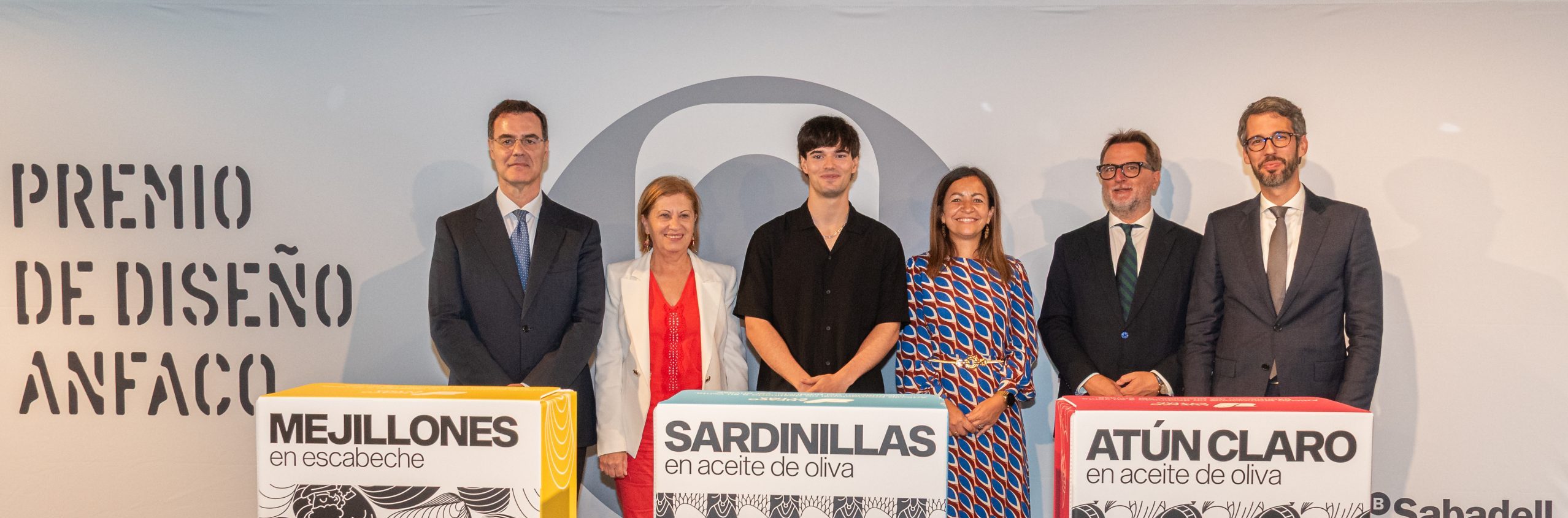
“The thought that something which started as an idea on my computer could become part of other people’s everyday lives is incredibly exciting to me.”
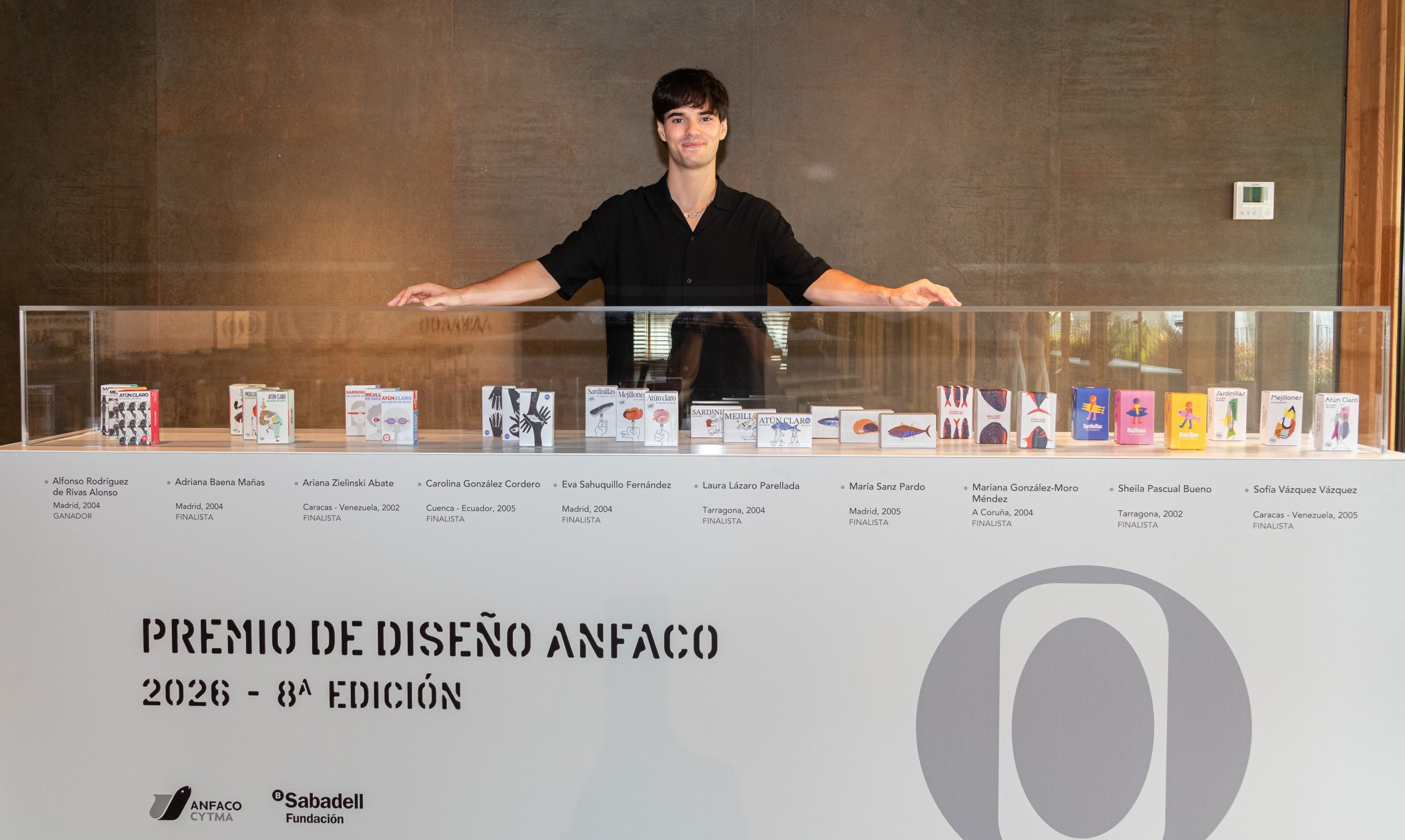
Alfonso Rodríguez de Rivas (Madrid, 2004), who is currently completing a Bachelor’s degree in Multimedia and Graphic Design at UDIT, has won the 8th ANFACO Design Award, a competition supported by our Foundation that has established itself as a leading platform for emerging talent in graphic design.
This year’s edition attracted strong participation, with 203 submissions from young designers representing 19 nationalities and 26 schools and universities. The winning project, entitled “Todo encaja” (“Everything Fits”), was praised by the jury for “the proposal’s strong visual impact, based on the contrast between black and white as its main graphic resource.”
The winning design will be featured on the packaging of the cans used in the “Cata la Lata” (“Taste the Can”) campaign, which promotes the consumption of canned fish and seafood over the coming year. You can explore the shortlisted proposals in this digital catalogue.
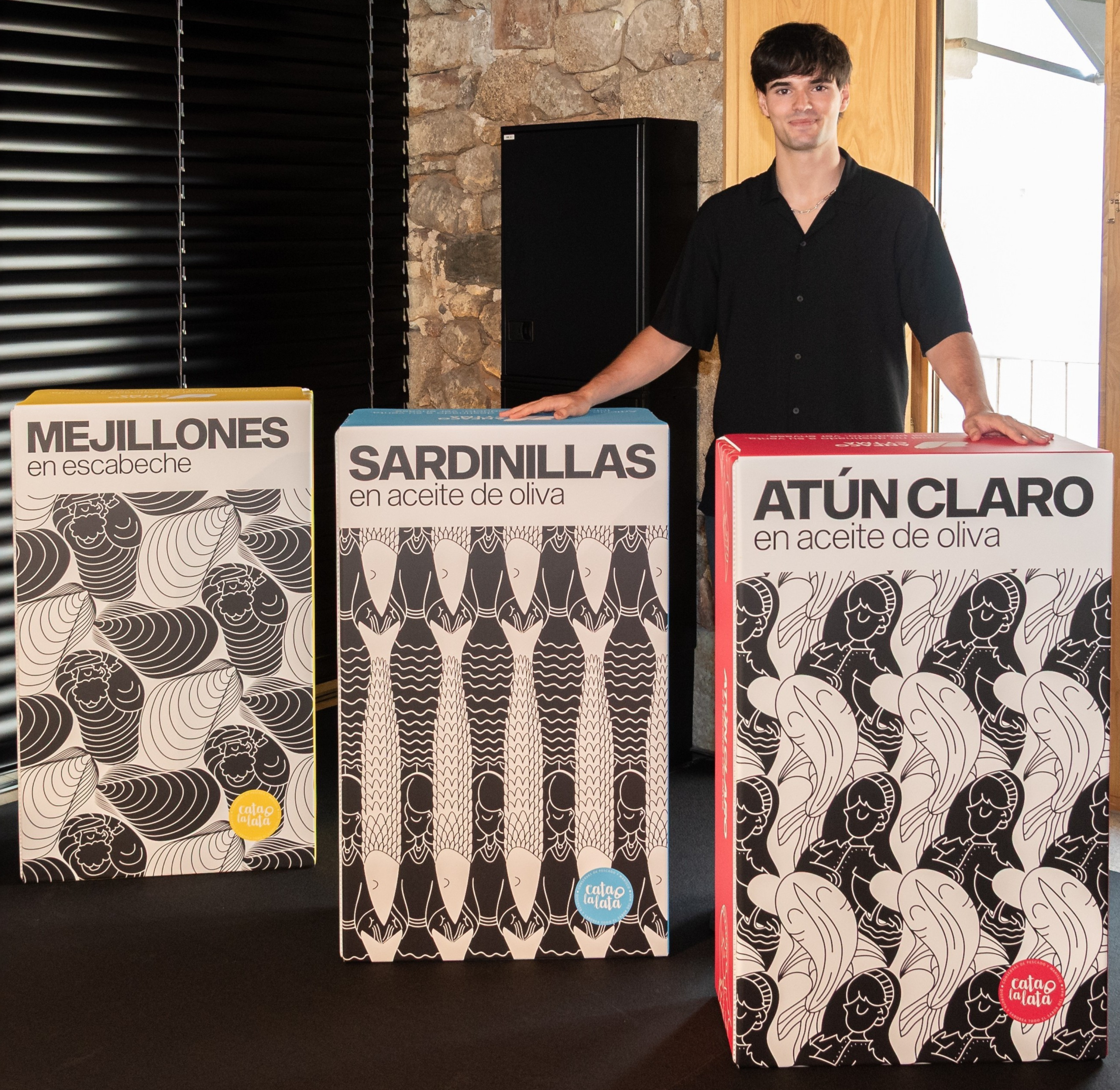
We speak with the winner, Alfonso Rodríguez de Rivas
Over the past few years, Alfonso Rodríguez de Rivas has developed a strong interest in art direction, branding, 3D design, type design and creative coding, always seeking projects with a solid conceptual foundation and a timeless aesthetic. He recently completed an internship at Mateo&Co, a studio specialising in food and gastronomy communication, and was selected alongside his team at the Laus Awards for an editorial project developed during his degree.
What does winning the ANFACO Design Award mean to you?
To be honest, it came as quite a surprise. Whenever you enter a competition like this, you’re hopeful and you think your proposal has a chance, but you never really expect to win.
It means a great deal to me because it’s one of the first times I’ve seen one of my projects move beyond the academic environment and have the opportunity to become something real.
The thought that something which started as an idea on my computer could become part of other people’s everyday lives is incredibly exciting to me. It has also given me the confidence to keep working, keep learning and keep believing in ideas that may not seem the most obvious at first.
Can you tell us about your winning design and what inspired you to create it?
The idea came from a book that has been in my father’s house for years, The Magic of M. C. Escher. I’ve always been fascinated by his tessellations, his optical illusions and the way he created endless patterns in which one shape gradually transforms into another almost without you noticing.
From there, I started thinking about how I could bring that visual language into the world of canned seafood. I found it interesting to connect marine life and seafood products with traditions, characters and customs associated with Galicia.
That led to three different tessellations, one for each product. The mussel design features a figure inspired by the people who harvest mussels in the Galician estuaries; the sardine design is inspired by the Maruxainas; and the tuna design depicts a woman carrying a basket, representing the tradition of going to the market to buy fresh produce.
What interested me most was ensuring that each can had a small story behind it and that the design went beyond simply depicting the product in a literal way.
What was your process from the initial idea to the final result?
I began by doing a great deal of research. I looked at can designs, contemporary packaging, previous winning entries and current visual styles to understand what had already been done and what I could contribute that was different.
I then researched the products themselves, how the seafood is harvested before being canned, and the stories, traditions and curiosities associated with Galicia. I wanted the designs to have depth rather than simply serving as decorative patterns.
Once I had a clear concept, I started considering which type of tessellation would best suit each can. Sardines, being long and narrow, called for a more vertical pattern arranged almost like rows, reflecting the way they are packed inside the can. Mussels worked better with a more compact, circular repetition. The tuna design eventually evolved into a kind of visual braid inspired by the swimming motion of fish.
It was a process of constant testing, revising and refining until all three designs worked individually while also forming a coherent collection.
What advice would you give to young designers who are just starting out?
I would probably tell them not to be overly influenced by trends. Nowadays it’s very easy to open TikTok or Instagram and find countless videos about the latest graphic style, the trends of the year or what you’re supposedly expected to do in order to stand out.
I think it’s important to stay aware of what’s happening around you, but I would avoid designing solely with that in mind. For me, it’s essential to get to the root of ideas and aim to create projects that are as timeless as possible. A design should be well constructed, well justified and able to stand the test of time. There’s little point in creating something that feels outdated after just a month.
I’d also encourage them to explore subjects that don’t seem related to design at all. Anything can inspire an idea: a biology book, physics, an industrial process, a historical fact, an old photograph, an article or an unexpected curiosity you come across by chance. Very often, a reference that appears far removed from design ends up being exactly what gives a project its meaning.
How do you value the support and visibility that organisations such as ANFACO-CYTMA and Fundación Banco Sabadell provide to young talent?
I value it enormously, especially because when you’re in your final year of university and about to enter the professional world, it’s natural to feel a little overwhelmed. You’ve spent years developing projects, learning and dedicating countless hours, yet you often don’t know whether your work has value beyond the university environment.
That’s why I believe initiatives like this make such a difference. They give you the opportunity to show your work to professionals already established in the field and see how they respond to it. In my case, winning this award has given me a great deal of confidence that I’m heading in the right direction.
I also believe there’s an incredible amount of talent among young designers, but not always enough opportunities to showcase it. Support like this, both through the visibility it provides and its financial contribution, can make a real difference at the beginning of a career—whether that’s helping you continue your education, pay for software licences and tools, or simply giving you the reassurance that your work is valued.
Finally, I think initiatives like this also help address an issue that still exists in Spain: the undervaluation of design. Design is sometimes seen as something secondary, when in reality it surrounds us every day, even if we don’t always realise it.